
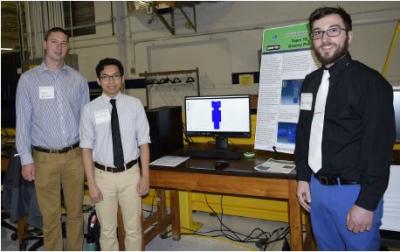
 On May 8, 2017, the students from the University of Rhode Island (URI) presented the final design report for their Capstone Project with Groov-Pin.
Laeng Khoun (project manager), Josh Blacker (research engineer), and Tyler Kelly (CAD/FEA engineer) called themselves Team Groovy-Pin. Their report stated that their project analyzed the forces, torque, and deformation caused through thread forming and failure using finite element analysis in a program called Abaqus.
Groov-Pin’s Threaded Inserts are designed to be user-friendly and allow design engineers to utilize the maximum amount of strength available. The students analyzed both self-tapping inserts and inserts that fit into pre-tapped holes.
After developing multiple concepts for this project, the team worked with Groov-Pin to narrow down their ideas to three finite element analysis simulations: a pull-out resistance simulation, a deformation of insert simulation, and a prevailing torque simulation. The goal was to create these simulations to enable design engineers to predict how these forces could affect their applications.
The team worked with CEO Scot A. Jones and Junior Engineer Jon Dupre. Jon graduated from URI in 2015 and enjoyed working with the students. “I like being able to help students because I was in that position not too long ago,” Jon said.
Team Groovy-Pin created models in Abaqus to replicate the physical tests Groov-Pin performs on its inserts. Through their classes at URI and working with Groov-Pin, the students were able to gain a better understanding of Abaqus. “The program they use is not that intuitive if you just said down to use it,” said Jon. “They took a class at URI, like I did when I was there, but it doesn’t come close to touching everything the program can do. They came a long way with the program and what they were able to accomplish.”
Team Groovy-Pin reported that the pull-out resistance simulation demonstrated that the top three threads of the insert received the highest amount of stress and deformation. They also said the deformation simulation was able to deform the threaded insert at four specific points to match the manufacturing process. These deformations created a tighter fit between the exterior threads of a bolt and the interior threads of the insert.
“Team Groovy-Pin successfully completed both the deformation and pull-out resistance FEA models. The results from these experiments were found to be accurate to similar physical experiments,” the team stated.
The team did not have time to complete the prevailing torque experiment, but the model they created has the necessary components for further exploration by Groov-Pin.
Groov-Pin enjoyed working with these students. We are proud of the work they put in and the results they accomplished.