
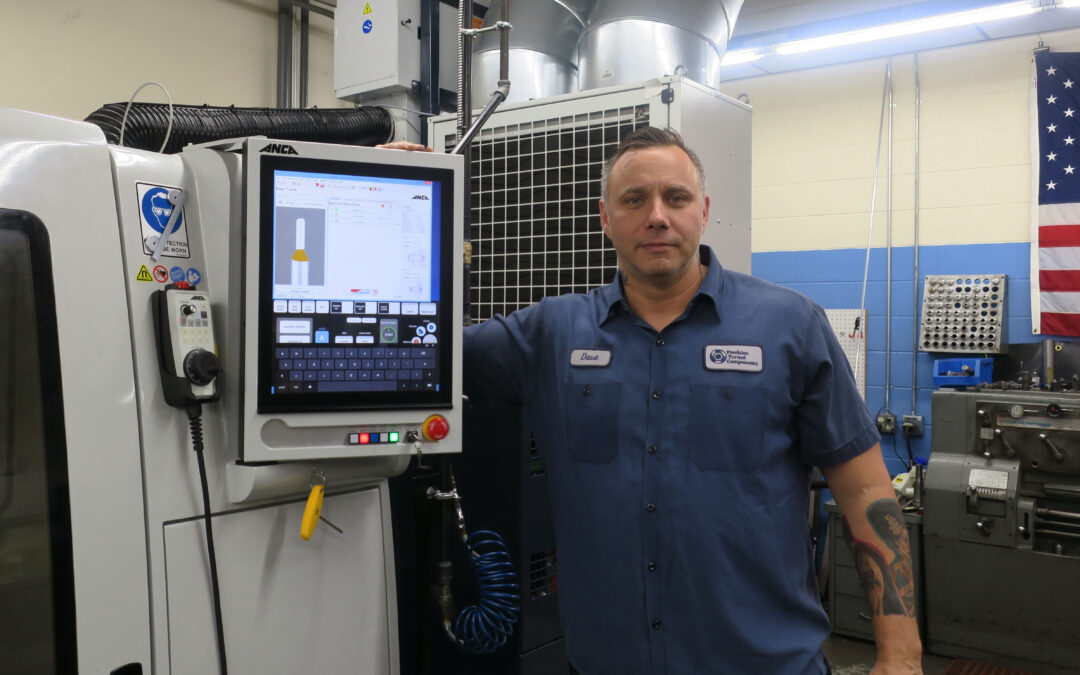
Groov-Pin’s tool maker, Dave Beland, has supported our manufacturing efforts by making tooling and providing mechanical support for more than 18 years.
Dave graduated from the Machine Technology Program at Davies Career & Technical High School in Lincoln, Rhode Island. While at school, he competed in interscholastic trade competitions through the Vocational Industrial Clubs of America (VICA), which is now called SkillsUSA, and international competitions.
Before graduation, he started working in local machine shops through a co-op program to learn about the different industries machine shops catered to. At the time, the prevalent industries included textiles, wire and cable, and die casting.
Dave learned how to operate equipment and run different machines, essentially putting himself through an apprenticeship. The exposure gave him experience and the ability to look for new opportunities.
He eventually responded to an ad for a wire EDM operator at Groov-Pin’s subsidiary, Precision Turned Components (PTC). When he started at PTC, he already had 10 years of experience as a general machinist under his belt. “I started doing more and more. I started learning how to grind tools and took the opportunity to learn more skills,” he said.
The most challenging part of his job can be time restraints when multiple orders come in. When an order comes in, Dave gets prints from engineering, makes the tools, and puts everything together in a kit so the set-up guys have everything they need. “I make the job-specific or custom tools for screw machine parts,” he said. “The custom tools are carbide tools and they’re either made on 5-Axis cutter grinders and insert OD tools are made on wire EDM machines.” The tools that don’t fall into those categories are made on manual grinders.
Dave also trains interns in the tool room. “I don’t have expectations for what interns should be doing, they need to find their own way for however they want their careers to pan out,” he said. This approach allows interns to decide what will be most beneficial to their career paths.
“I can do so many different aspects of machining – CNC, manual, computer programming – so I let interns get an idea for what part of the job they like,” he said. His past experiences influence the way he works with interns and his view that potential employees need to find their own path.